Mykonos to Santorini: Ferries, Flights and Which Island Wins
The most-travelled hop in the Cyclades. A high-speed ferry does it in about two and a half hours, the two islands are far less alike than the photos suggest, and the wind decides more than the timetable does.
SANTORINI · MARINAKIS TOURS
The answer, at a glance
How long is the ferry from Mykonos to Santorini?
2 to 3 hours on a high-speed catamaran, depending on the operator and whether the sailing stops at Naxos, Paros or Ios on the way. Check the routing rather than just the departure time.
How much is the ferry from Mykonos to Santorini?
Typically €60–€110 each way, varying with operator, season and seat class. Book ahead for August sailings, which genuinely sell out.
How to get from Mykonos to Santorini
Ferry, essentially. The two islands are around 70 nautical miles apart and high-speed catamarans link them in roughly 2 to 3 hours depending on the operator and how many islands the sailing stops at.
Direct flights between Mykonos and Santorini exist only as limited seasonal services and are frequently not available at all. Flying otherwise means routing through Athens, which turns a two-hour boat ride into most of a day. For this particular hop, the ferry is not the budget option, it is the sensible one.
Sailings run roughly April to early November. Outside that window there is very little direct service, and winter island-hopping between the two generally means going back through Athens or Piraeus.
| High-speed ferry | Via Athens by air | |
|---|---|---|
| Journey time | 2–3 hrs | 5–7 hrs total |
| Typical fare | €60–€110 | €120–€300+ |
| Season | ~Apr–early Nov | Year-round |
| Departs from | Mykonos New Port (Tourlos) | Mykonos Airport (JMK) |
| Wind cancellations | Common in meltemi season | Rare |
| Luggage | Free, generous | Charged, restricted |
Some sailings call at Naxos, Paros or Ios en route, which adds time. Check the routing, not just the departure time.
Which port do you leave from?
Mykonos New Port at Tourlos, roughly 2 km north of Mykonos Town. This trips people up constantly, because the Old Port in town is the one everyone knows and the one the cruise tenders use.
Almost all high-speed ferries to Santorini leave from the New Port. Check your ticket, allow 20 to 30 minutes to get there from town, and arrive at least 30 minutes before departure. Taxis on Mykonos are scarce in the same way they are on Santorini, so do not leave the transfer to chance in August.
- New Port (Tourlos), ~2 km north of Mykonos Town, not the Old Port
- Allow 20–30 minutes from town, more in peak traffic
- Be at the port 30 minutes before departure; boarding closes properly
- Confirm which port is printed on your ticket before travel day
The wind problem
The meltemi is a strong, dry northerly that blows across the Aegean from roughly July into September. It is not a storm and it is not unusual, it is the normal summer weather pattern, and it can run for days.
High-speed catamarans are light and are the first vessels pulled from service when it blows. Cancellations on the Mykonos–Santorini route are a routine feature of August, not a rare event. Larger conventional ferries cope far better but serve this route less frequently.
The practical advice: do not schedule this crossing on the same day as an international flight home, and do not book the last sailing of the day if anything depends on arriving. Leave a day of slack in an island-hopping itinerary. If a crossing is cancelled, operators generally rebook or refund, but they cannot conjure a boat that is not sailing.
- Meltemi season runs roughly July to September
- High-speed catamarans are cancelled first
- Never connect this crossing directly to an international departure
- Build a spare day into any island-hopping plan
Mykonos vs Santorini: which is right for you?
They get lumped together as the two famous Cycladic islands, and they are genuinely different places serving different holidays.
Mykonos is flat, sandy and social. The beaches are the attraction, Paradise, Super Paradise, Elia, Psarou, and the island's centre of gravity is nightlife, beach clubs and a very good restaurant scene. It is where you go to be out.
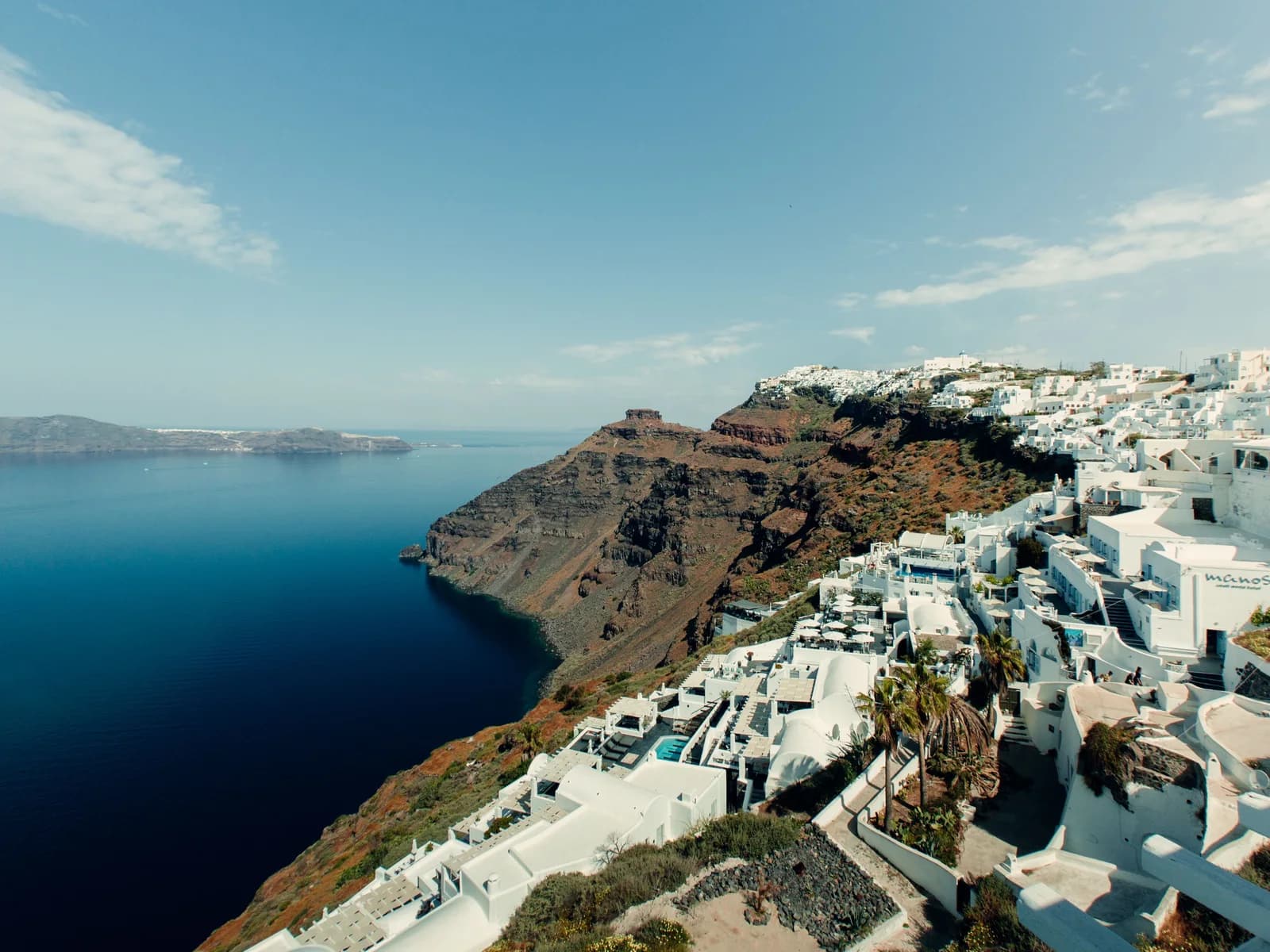
Santorini is a drowned volcano. The 'beaches' are black volcanic sand and, honestly, not the reason to come; the landscape is. The caldera cliff, the villages stacked along its rim, the sunsets, the wineries growing Assyrtiko in basket-woven vines, the Bronze Age site at Akrotiri. It is more scenic, more expensive, and considerably more about looking at things than lying on them.
If you have a week, do both, the ferry makes that easy in summer. If you have four days, pick the one that matches the holiday you actually want rather than trying to split it.
| Mykonos | Santorini | |
|---|---|---|
| Best for | Beaches, nightlife, beach clubs | Scenery, sunsets, wine, ruins |
| Beaches | Excellent, sandy | Black volcanic sand, dramatic not comfortable |
| Nightlife | Among the best in Europe | Present but low-key |
| Getting around | Buses, quad hire, scarce taxis | Buses via Fira, taxis and app requests |
| Terrain | Flat and easy | Steep, stepped, lots of walking |
| Couples / honeymoon | Good | Exceptional |
| Families | Easier, flat, sandy, swimmable | Harder, steps, cliffs, heat |
Arriving in Santorini from Mykonos
Ferries from Mykonos arrive at Athinios, Santorini’s commercial ferry port below the caldera. Follow the operator’s arrival instructions and plan onward transport before disembarking.
Taxi availability and road traffic vary around arrivals. Uber lists Santorini taxi requests; check current pickup options in the app. For a confirmed Marinakis transfer, share your ferry, date, group size and luggage so the team can arrange the meeting details.
- All Mykonos ferries arrive at Athinios, not the old port below Fira
- Athinios to Fira: 20–30 minutes; to Oia: 40–50 minutes
- No terminal building and very little shade at the port
- Ferry tracking on a booked transfer means delays cost you nothing
Good questions. Clear answers.
How long is the ferry from Mykonos to Santorini?
2 to 3 hours on a high-speed catamaran, depending on the operator and whether the sailing stops at Naxos, Paros or Ios on the way. Check the routing rather than just the departure time.
How much is the ferry from Mykonos to Santorini?
Typically €60–€110 each way, varying with operator, season and seat class. Book ahead for August sailings, which genuinely sell out.
Is there a direct flight from Mykonos to Santorini?
Only as a limited seasonal service, and often not at all. Flying otherwise means connecting through Athens, which takes most of a day. The ferry is the practical choice for this route.
Which port does the Santorini ferry leave from in Mykonos?
The New Port at Tourlos, about 2 km north of Mykonos Town, not the Old Port in town. Allow 20–30 minutes to get there and arrive 30 minutes before departure.
Do ferries run from Mykonos to Santorini in winter?
Very limited. Direct high-speed service runs roughly April to early November. Outside that, expect to route via Athens or Piraeus.
Is Mykonos or Santorini better?
Different holidays. Mykonos is flat, sandy and social, beaches and nightlife. Santorini is a volcanic caldera, scenery, sunsets, wine and archaeology, with black sand rather than good swimming beaches. Neither is objectively better.
Can I visit both Mykonos and Santorini in one trip?
Easily, in summer. A week is comfortable for both. Leave a spare day of slack in the itinerary in case the meltemi cancels a crossing, and never connect a ferry directly to an international flight home.