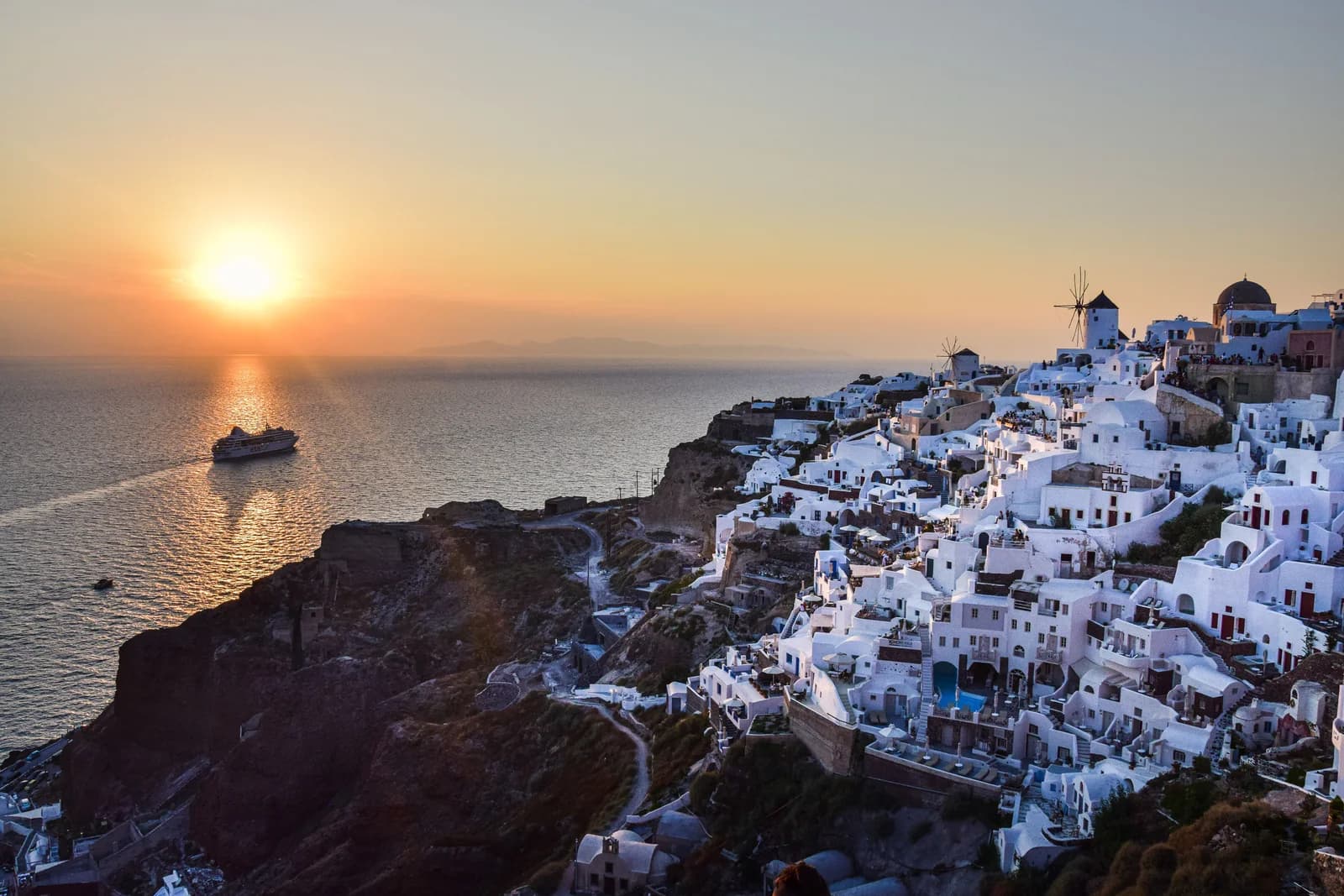
Santorini Beaches: An Honest Guide
Santorini's beaches are volcanic, black, red and white sand and pebble, backed by cliffs. They are extraordinary to look at and, we should be upfront, not the island's strongest feature. Here is which ones are genuinely worth your day and which are worth twenty minutes and a photograph.
SANTORINI · MARINAKIS TOURS
The answer, at a glance
Does Santorini have good beaches?
It has dramatic beaches rather than comfortable ones. The sand is black or red volcanic grit that gets very hot, and most shelve steeply. Kamari, Perissa and Perivolos are well-organised and genuinely enjoyable; if beaches are your holiday's main purpose, Naxos or Mykonos suit better.
What is the best beach in Santorini?
Perissa or Perivolos for a full day with facilities, Kamari for families, Vlychada for something quieter and stranger. Red Beach is the most striking to look at but the least practical to actually use.
What Santorini beaches are actually like
There is no white sand here. The island is a collapsed volcano and its beaches are made of what the volcano left: black basalt grit, red scoria, grey pebble.
Two consequences matter. First, dark sand absorbs heat, by midday in August it is genuinely too hot to cross barefoot, and you will want sandals to reach the water. Second, most beaches shelve steeply into deep water quickly, which suits swimmers and less so small children.
Set against that: the settings are dramatic in a way ordinary beaches are not, the water is clear and clean, and the organised beaches on the east and south coasts are well run with sunbeds, tavernas and calm shallow entry. Go in with the right expectation and they are a good day out. Go expecting the Caribbean and you will be disappointed.
- Black and red volcanic sand, not white, and it gets very hot
- Bring sandals you can walk to the water in
- Most beaches are on the east and south coasts, not the caldera side
- The caldera cliff has almost no accessible beach at all
- Water is clear, clean and usually calm on the east coast
The organised beaches: Kamari, Perissa, Perivolos
These three are the island's proper beach days. All are long stretches of black sand on the east and south coasts, all are flat and walkable, and all have sunbeds, tavernas, watersports and easy parking.
Kamari is the most family-oriented, backed by a paved promenade of restaurants and shops beneath the huge rock of Mesa Vouno. Perissa is on the other side of the same rock, slightly younger in feel and a little cheaper. Perivolos, running south from Perissa, is where the beach clubs are, loungers, cocktails, music, and the closest Santorini gets to a Mykonos beach scene.
If you want one beach day and want it to be straightforward, pick one of these.
| Beach | Best for | Sand | Facilities |
|---|---|---|---|
| Kamari | Families, promenade dining | Black, coarse | Excellent |
| Perissa | Value, longer stretch | Black, fine | Excellent |
| Perivolos | Beach clubs, day-drinking | Black, fine | Excellent |
| Vlychada | Quiet, lunar cliffs | Grey-white | Moderate |
| Monolithos | Young children, shallow | Dark, soft | Good |
Red Beach: worth seeing, hard to use
Red Beach near Akrotiri is the island's most photographed stretch of coast, a small cove of rust-red sand beneath towering red-and-black cliffs. It genuinely looks like nowhere else in Greece.
It is also small, extremely crowded in season, and sits beneath an actively unstable cliff. Rockfall has been a persistent problem, access has been restricted at various times, and warning signs are posted for good reason. Treat those signs as real rather than decorative.
Our honest advice: walk the short path from the car park to the viewpoint above, take the photograph, and swim somewhere else. The view is the point. As a beach day it is cramped, pebbly underfoot and offers minimal shade. Some boat tours pass it from the water, which is arguably the best way to see it.
- Reached by a short rough path from a car park near Akrotiri
- Genuinely spectacular from the viewpoint above
- Rockfall risk is real, heed posted closures
- Small, crowded, pebbly and short on shade
- Best seen from the viewpoint or from a boat
White Beach and the boat-access coves
White Beach sits just along the coast from Red Beach beneath pale cliffs, and is reachable only by boat, a small water taxi runs across from Akrotiri in season. That inaccessibility is exactly why it stays pleasant.
The same applies to several coves along the southwestern coast. The catamaran cruises that circle the caldera stop at Red and White Beach for snorkelling, which is the least effortful way to see both, and they continue to the hot springs off Nea Kameni. If beaches are a secondary interest rather than your main one, a half-day cruise covers more of the good coastline in five hours than a week of driving to car parks would.
Vlychada and the quiet end
Vlychada, on the south coast, is the island's most unusual beach, backed by pale volcanic cliffs eroded into smooth, wind-carved forms that look more like a desert canyon than a Greek coastline. It is quieter than Perissa, has a small marina and a couple of good tavernas, and rewards a late afternoon rather than a full day.
For something genuinely empty, the beaches at the northern end near Baxedes and Paradisos see a fraction of the traffic, though they are exposed to the northerly wind and have few facilities. On a meltemi day they are unusable; on a calm day they are the closest thing to a private beach on Santorini.
Getting to the beaches
Buses run from the Fira terminal to Kamari, Perissa and Akrotiri, and are a perfectly good option in the middle of the day. They are less good in the evening and non-existent late.
Beach-hopping by bus is impractical, though, because almost every route goes back through Fira, getting from Kamari to Perissa, two beaches either side of the same rock, means a round trip through the capital. A private tour or a driver for the afternoon solves that, and lets you take in Akrotiri, the Red Beach viewpoint, Vlychada and a winery in one loop rather than three separate journeys.
- Buses reach Kamari, Perissa and Akrotiri from Fira
- Nearly every route goes via Fira, direct beach-to-beach is rare
- Evening services thin out sharply
- The south-coast loop works far better with a vehicle
Domande utili. Risposte chiare.
Does Santorini have good beaches?
It has dramatic beaches rather than comfortable ones. The sand is black or red volcanic grit that gets very hot, and most shelve steeply. Kamari, Perissa and Perivolos are well-organised and genuinely enjoyable; if beaches are your holiday's main purpose, Naxos or Mykonos suit better.
What is the best beach in Santorini?
Perissa or Perivolos for a full day with facilities, Kamari for families, Vlychada for something quieter and stranger. Red Beach is the most striking to look at but the least practical to actually use.
Can you swim at Red Beach in Santorini?
Sometimes, access has been restricted at various points because of genuine rockfall risk from the unstable cliff above. Check the posted signs on the day and take them seriously. Most visitors are better served by the viewpoint above or by seeing it from a boat.
Why is the sand black in Santorini?
The island is a collapsed volcano. The beaches are made of eroded basalt and volcanic rock rather than coral or quartz, which is why they are black, red or grey, and why they get hot enough to need sandals by midday.
Are there any white sand beaches in Santorini?
No true white sand. White Beach, near Red Beach, is named for its pale cliffs rather than its sand and is reachable only by boat. Vlychada has the lightest sand on the island.
Which beach is best for children?
Monolithos, it has the shallowest entry and softest sand on the island, plus a playground and shade. Kamari is the next best, with a promenade of restaurants right behind the beach.
Can you walk to a beach from Oia or Fira?
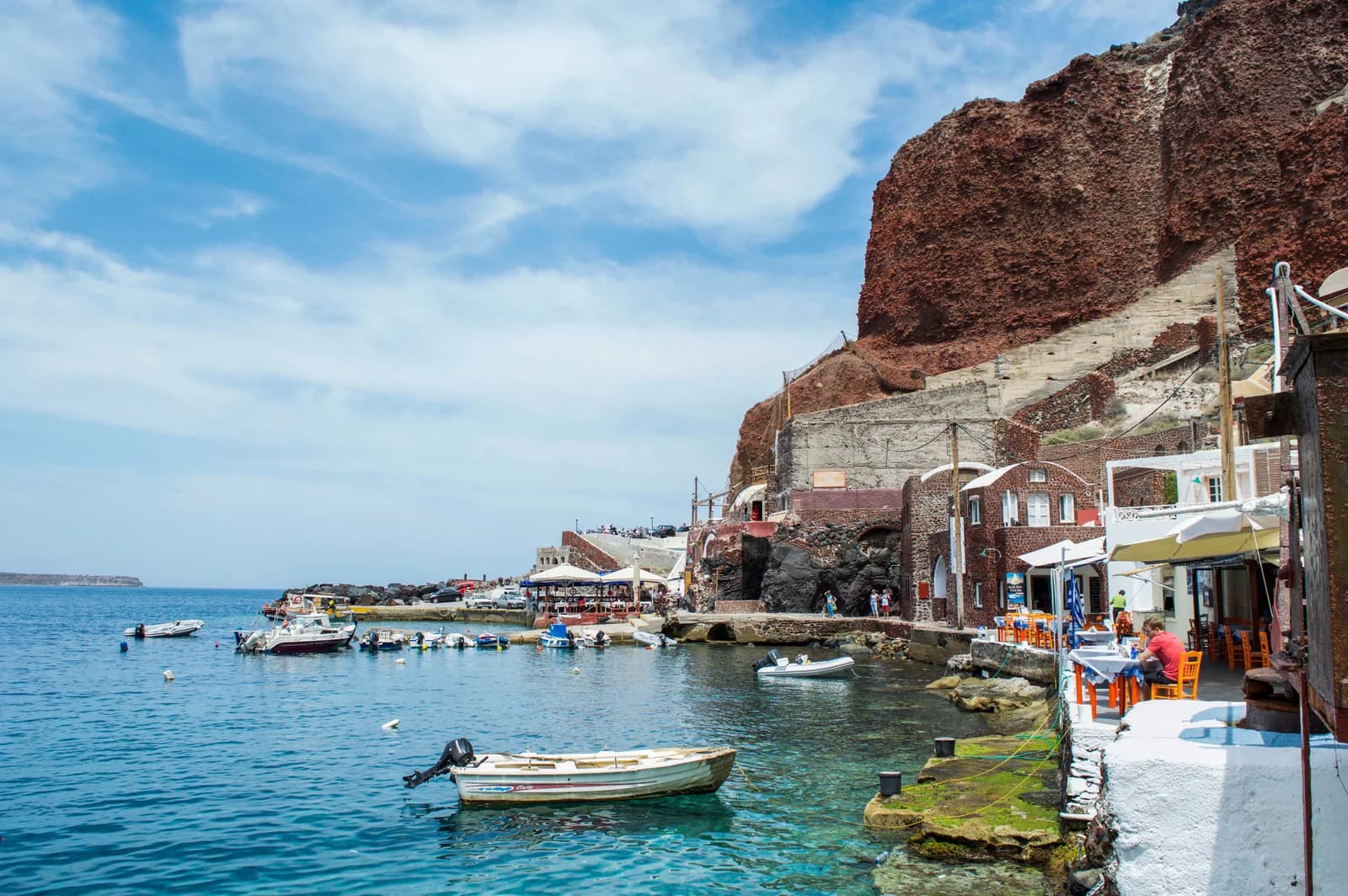
Not really. The caldera side is a 300-metre cliff with essentially no beach. Ammoudi below Oia has swimming off rocks rather than a beach. All the real beaches are on the east and south coasts, a 15–25 minute drive away.