The Santorini Cable Car and the Old Port
Two hundred and twenty metres of cliff separate Fira from the old port below it. There are three ways up and only one of them is a good idea. If you are arriving by cruise ship, this queue is the single biggest constraint on your day ashore.
SANTORINI · MARINAKIS TOURS
The answer, at a glance
How much is the Santorini cable car?
A small cash fare each way, paid at the station, a few euros per person, with a reduced rate for children. Bring cash; the queue is not the place to discover the card machine is down.
How long is the cable car queue in Santorini?
Typically 45–60 minutes at peak on a cruise day, and the afternoon descent is usually worse than the morning ascent. Capacity is roughly 1,200 people an hour against ships that carry several thousand.
What the cable car is and where it goes
The Fira cable car runs from the edge of Fira town down to the old port at sea level, a drop of about 220 metres. The ride takes roughly three minutes and was donated to the island in the late 1970s by the Nomikos family, on the condition that a share of the revenue went to the mule owners whose trade it displaced.
It is the only mechanical link between Fira and the water. The old port is where cruise tenders land and where many volcano and excursion boats depart, it is not the same place as Athinios, the commercial ferry port further south, which handles the large ferries from Piraeus, Mykonos and Crete.
That distinction catches people out regularly. If your ticket says Athinios, the cable car has nothing to do with your journey.
- 220 m vertical drop, about a 3-minute ride
- Connects Fira town to the old port only
- Serves cruise tenders and excursion boats
- Not connected to Athinios, the main ferry port
- Runs roughly every 20 minutes, more frequently on busy cruise days
The queue is the whole story
The cable car moves in the order of 1,200 people an hour. A single large cruise ship carries considerably more than that, and on a busy morning there may be two or three ships anchored in the caldera at once.
The arithmetic does not work, and the result is a queue. Forty-five to sixty minutes at peak is normal rather than exceptional.
The less obvious point is that the afternoon descent is usually worse than the morning ascent. Passengers trickle up across a couple of hours as tenders arrive, but everyone tries to go back down inside the same half hour before all-aboard. If you are planning a shore day, the down queue is the one to build your timing around.
- Capacity around 1,200 passengers per hour
- 45–60 minute waits are normal at peak
- The afternoon descent is typically the worse queue
- Multiple ships in port compounds it sharply
- Small cash fare each way, paid at the station
The other two options, and why we only recommend one
There are 588 steps zigzagging up the cliff between the old port and Fira, and they are shared with the mules.
Walking is free and takes 25 to 40 minutes uphill. In practice it is unpleasant: the steps are uneven, there is no shade, and the surface is fouled by the animals that use it. Going down is easier but slippery. If you are fit, travelling light and the queue is genuinely enormous, it is a legitimate escape route. Most people who try it in August regret it.
Riding the mules is the third option and we would ask you not to. The welfare conditions have drawn sustained criticism from Greek and international animal charities, overwork in extreme heat, inadequate rest and water, harness injuries, and passenger weight limits that are frequently ignored. Greek authorities have introduced weight restrictions in response, with mixed enforcement. It is a genuinely contested practice rather than local colour, and the cable car exists precisely to replace it.
- 588 steps, 25–40 minutes uphill, no shade, shared with mules
- Free, and a reasonable fallback if the queue is extreme
- Mule rides raise well-documented animal welfare concerns
- The cable car was donated specifically to replace the mule trade
If you are arriving by cruise ship
Plan the day backwards from your all-aboard time, not forwards from your tender.
A workable shape: tender ashore early, take the cable car up before the main wave, spend four to six hours on the island, and return to the top station with a clear hour in hand before you need to be back on the ship. That hour is not padding, it is the down queue.
Ship-organised excursions guarantee the ship waits for you. Independent tours do not, which is the real trade-off. What you get instead is a private vehicle rather than a coach for fifty, an itinerary you choose and, for a family, usually a considerably lower cost. We meet cruise guests at the top cable-car station with a name sign and reverse-plan the itinerary around your all-aboard time.
- Go up early, before the main tender wave
- Allow a full hour at the top station for the descent queue
- Ship excursions guarantee the ship waits; independent ones do not
- We meet guests at the upper station with a name sign
The old port itself
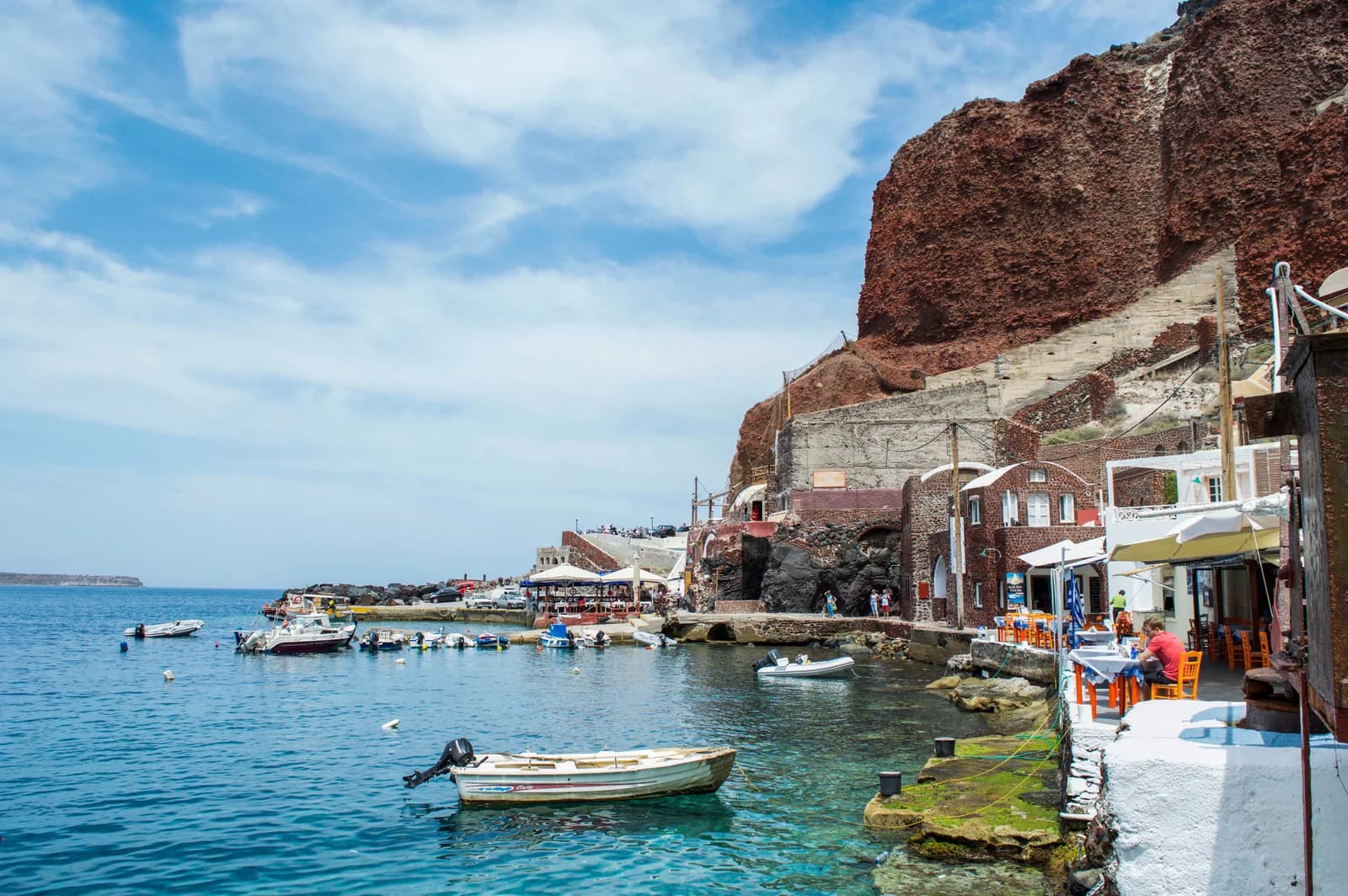
Small, and mostly a transit point rather than a destination. There are a handful of tavernas and souvenir shops along the quay, tender berths, and the departure points for volcano boats and some catamaran cruises.
If your boat trip leaves from here, factor the cable car into your departure time, arriving at the top station ten minutes before your sailing is not enough. Some operators instead depart from Athinios or from Ammoudi below Oia, so check which one your ticket names.
There is no beach and no swimming worth the name. It is a working harbour at the foot of a cliff.
Gute Fragen. Klare Antworten.
How much is the Santorini cable car?
A small cash fare each way, paid at the station, a few euros per person, with a reduced rate for children. Bring cash; the queue is not the place to discover the card machine is down.
How long is the cable car queue in Santorini?
Typically 45–60 minutes at peak on a cruise day, and the afternoon descent is usually worse than the morning ascent. Capacity is roughly 1,200 people an hour against ships that carry several thousand.
How many steps are there from the old port to Fira?
588, zigzagging up the cliff and shared with the mules. Walking up takes 25–40 minutes with no shade, and the surface is fouled by the animals.
Should I ride the donkeys or mules in Santorini?
We would ask you not to. The welfare conditions have drawn sustained criticism from Greek and international animal charities over overwork in heat, inadequate rest and ignored weight limits. The cable car exists specifically to replace the practice.
Is the cable car the same as the ferry port?
No. The cable car connects Fira to the old port, which serves cruise tenders and excursion boats. The large ferries from Piraeus, Mykonos and Crete use Athinios, a separate commercial port further south with no cable car.
What time does the Santorini cable car run?
Broadly from early morning to late evening, with hours extended in high season and reduced in winter. Frequency increases on days with ships in port. Check locally for your date rather than relying on a published timetable.
Can I take luggage on the cable car?
Small bags yes, but it is not designed for suitcases and the cabins are cramped. If you are arriving with luggage you will almost certainly be coming into Athinios instead, where a road transfer is the sensible option.