Santorini Volcano Tour: Nea Kameni and the Hot Springs
Santorini is the rim of a drowned volcano, and the black island in the middle of the bay is still active. Here is what a volcano tour actually involves, how hard the climb is, whether the hot springs live up to the name, and how to choose between the boat options.
SANTORINI · MARINAKIS TOURS
The answer, at a glance
Is the Santorini volcano still active?
Yes, though dormant and continuously monitored. Nea Kameni's most recent eruptive activity was in the 1950s. It is genuinely active geology rather than an extinct feature, but it is not currently a cause for concern.
How hard is the volcano hike at Nea Kameni?
Moderate. It is 30–45 minutes up roughly 130 metres of ascent on loose volcanic gravel. Not technically difficult, but there is no shade at all and it is hard work in midsummer heat. Closed shoes are essential.
What you are actually looking at
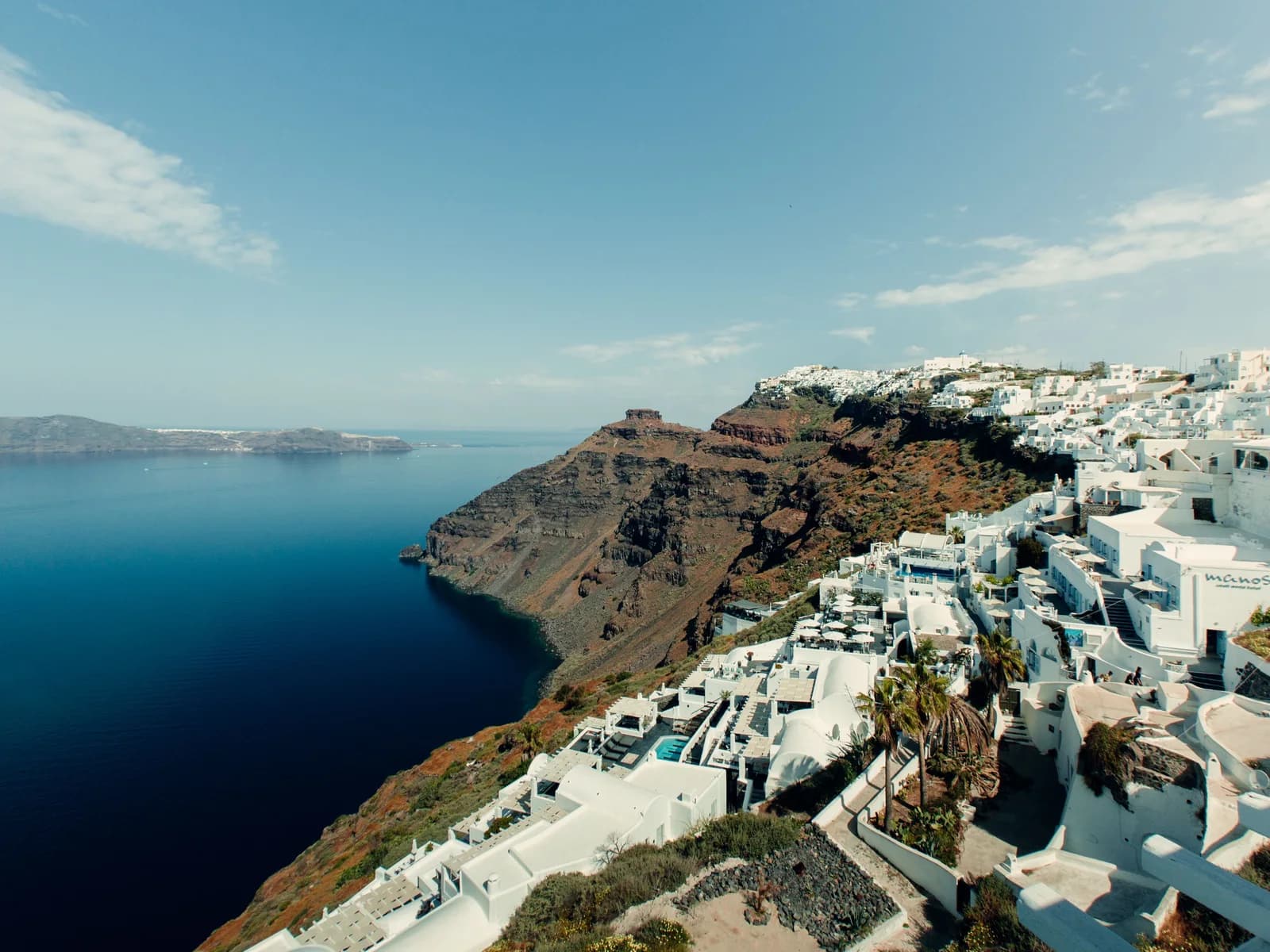
Around 1600 BC this island was roughly circular, with a mountain at its centre. That mountain erupted in one of the largest volcanic events in human history, the summit collapsed, and the sea flooded the void. What remains is the caldera: a ring of cliff with a flooded crater in the middle.
Nea Kameni and Palea Kameni, the two dark islets sitting in the bay, are newer. They are lava domes that have pushed up out of the crater floor over the last two thousand years. Nea Kameni's most recent activity was in the 1950s. The volcano is dormant, monitored constantly, and not currently a cause for concern, but it is genuinely active geology rather than a scenic ruin.
Standing on the crater rim looking back at the cliff villages is the clearest way to understand the island's shape. From the rim you cannot see what you are standing on; from the middle, it is obvious.
What a volcano tour involves
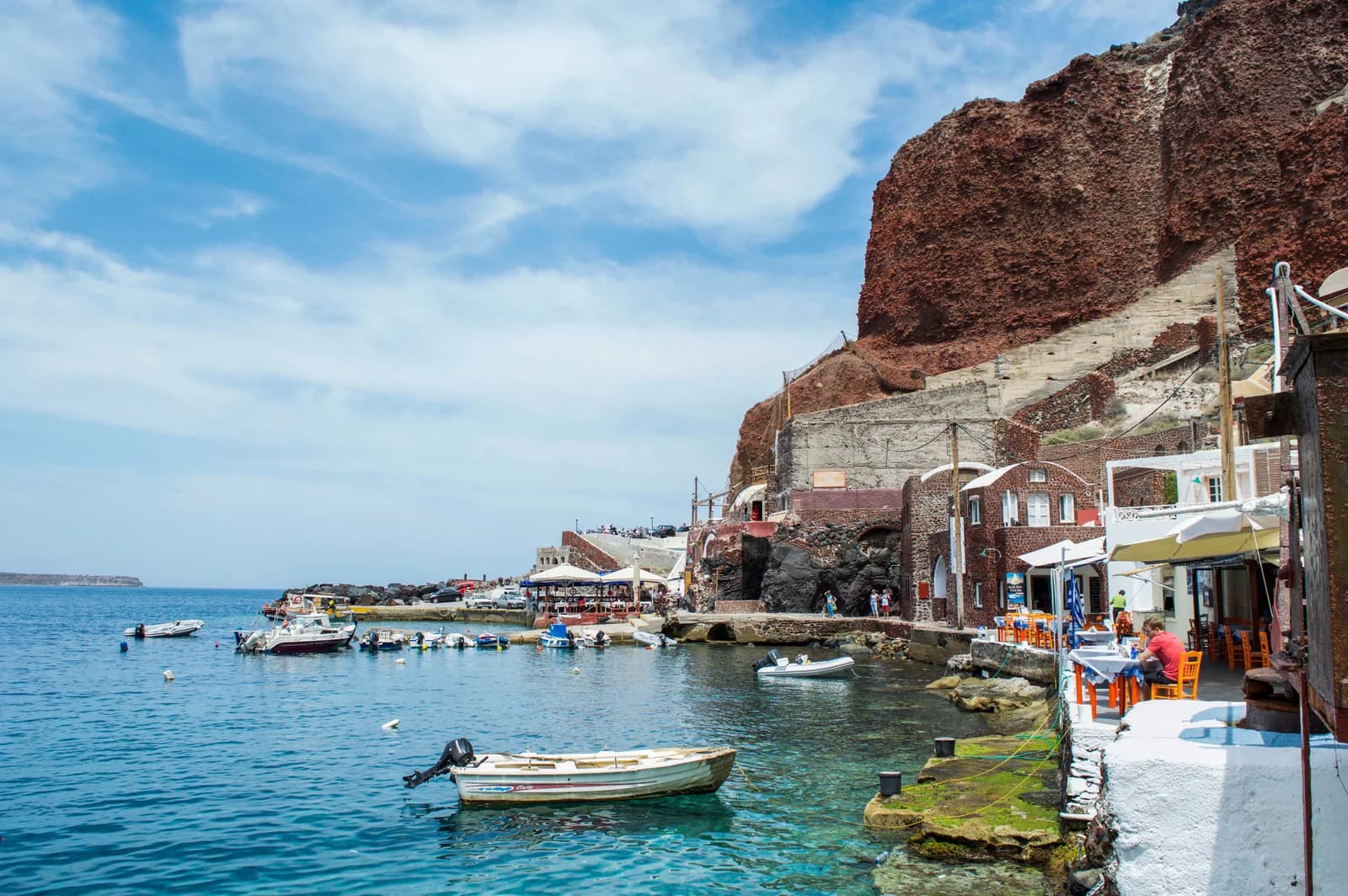
Boats leave from the old port below Fira, from Athinios, and from Ammoudi below Oia, depending on the operator. Most run a half-day circuit.
The standard itinerary crosses to Nea Kameni, where you land and walk up to the crater, about 30 to 45 minutes up a loose volcanic gravel path, roughly 130 metres of ascent. There is no shade anywhere on the island and the ground radiates heat. It is not technically difficult but it is genuinely hot work in July and August.
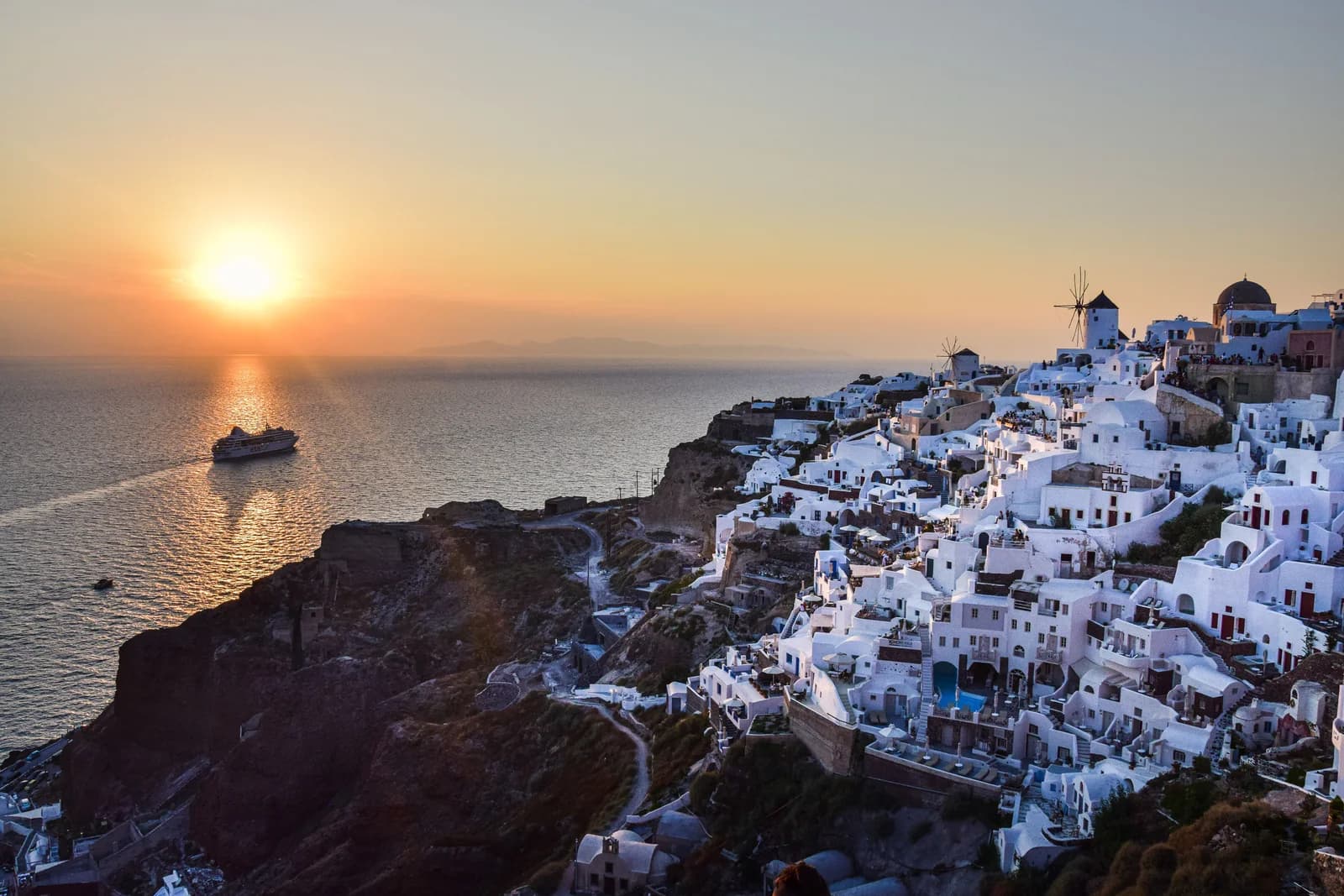
Most tours then move to Palea Kameni for the hot springs, and longer versions add Thirassia, the small inhabited island across the caldera, before returning past Oia at sunset.
- Departures from Fira old port, Athinios or Ammoudi
- Nea Kameni crater walk: 30–45 minutes up, ~130 m of ascent
- Loose volcanic gravel underfoot, closed shoes, not sandals
- No shade at all on the volcano; hat, water and sunscreen are essential
- A small landing fee for the volcano park is usually payable separately
The hot springs, honestly
Manage expectations here. The 'hot springs' at Palea Kameni are a small bay where warm sulphurous water seeps into the sea. The water is rust-orange from iron oxide and smells faintly of sulphur.
Boats generally moor a little way out and you swim in, 50 to 100 metres of cold open water before you reach the warm patch. The warm part is pleasantly tepid rather than hot; think a lukewarm bath, not a thermal spa. And the iron content stains light-coloured swimwear permanently, so wear something dark you do not care about.
It is a good experience and worth doing. It is not a spa, and anyone expecting one is reliably disappointed.
- You swim from the boat, usually 50–100 m in cold water first
- Warm rather than hot; comfortably tepid at best
- Iron oxide permanently stains light swimwear, wear dark colours
- Sulphur smell is noticeable but mild
- Not suitable for weak swimmers unless the boat offers a shorter mooring
Choosing your boat
The options differ more than the marketing suggests.
Large shared boats are the cheapest and busiest, carrying 80 to 200 passengers on a fixed schedule. You will queue to disembark at Nea Kameni and share the hot springs with several other boats. Fine if budget is the priority.
Traditional wooden caiques are mid-range, carry fewer people, and have more character.
Catamarans are a different product altogether. They are slower and cost more, but include a proper meal, drinks, snorkelling stops at Red and White Beach, and far fewer people on board. Most catamaran itineraries include the hot springs but skip the Nea Kameni crater climb, worth checking if summiting the volcano is the point for you.
Private charters give you the whole boat and the itinerary you want.
| Option | Group size | Crater climb | Includes |
|---|---|---|---|
| Large shared boat | 80–200 | Yes | Transport only |
| Wooden caique | 30–60 | Yes | Transport, sometimes lunch |
| Shared catamaran | 12–16 | Usually not | Meal, drinks, snorkelling, hot springs |
| Private charter | Up to 12 | On request | Fully customised |
Marinakis Tours does not operate volcano boats. We book catamaran cruises through our sailing partner and handle transfers to and from every departure point.
What we can and cannot help with
We should be straight about this. Marinakis Tours does not run volcano boat trips, those are operated by dedicated boat companies, and we would rather point you at them than pretend otherwise.
What we do handle is everything around the trip. Catamaran cruises through our sailing partner include the hot springs, snorkelling at Red and White Beach, a proper meal and drinks. Transfers to and from the old port, Athinios or Ammoudi are straightforward for us, and worth arranging, Ammoudi in particular is a steep descent below Oia with almost no parking, and getting back up after a day on the water is nobody's idea of fun.
A private tour also pairs well with a morning volcano trip: boat in the morning, wineries and villages in the afternoon, sunset where the crowds are not.
Practical notes
Go in the morning if you can. The afternoon boats are hotter, busier, and the crater path is genuinely unpleasant at 15:00 in August.
The volcano is exposed. There is no shade, no shop and no shelter on Nea Kameni, carry more water than you think you need. Closed shoes matter: the path is sharp volcanic scree that will shred flip-flops and the soles of your feet with them.
Sunset returns via Oia are lovely and are the main reason to take an afternoon sailing instead.
- Morning sailings are cooler and less crowded
- Closed shoes are essential, the path is sharp scree
- Carry at least a litre of water per person
- Dark swimwear for the hot springs
- Boats are cancelled in high wind, as with all Aegean sailings
实用问题,清晰解答。
Is the Santorini volcano still active?
Yes, though dormant and continuously monitored. Nea Kameni's most recent eruptive activity was in the 1950s. It is genuinely active geology rather than an extinct feature, but it is not currently a cause for concern.
How hard is the volcano hike at Nea Kameni?
Moderate. It is 30–45 minutes up roughly 130 metres of ascent on loose volcanic gravel. Not technically difficult, but there is no shade at all and it is hard work in midsummer heat. Closed shoes are essential.
Are the Santorini hot springs actually hot?
Warm rather than hot, comfortably tepid, more like a lukewarm bath than a thermal spa. You also swim 50–100 metres through cold sea to reach them from the boat. Worth doing, but manage expectations.
Will the hot springs stain my swimsuit?
Yes, permanently. The water is rich in iron oxide and turns light-coloured fabric rust-orange. Wear dark swimwear you are not attached to.
How long is a Santorini volcano tour?
A basic volcano and hot springs trip runs 3–5 hours. Adding Thirassia and a sunset return past Oia extends it to 6–8 hours. Catamaran cruises typically run about 5 hours.
Where do volcano boats leave from?
Mostly the old port below Fira, reached by cable car, donkey path or a steep road. Some depart from Athinios or from Ammoudi below Oia. Check which one your ticket specifies, they are far apart.
Does Marinakis Tours run volcano boat trips?
No. Volcano boats are run by dedicated operators. We book catamaran cruises through our sailing partner, which include the hot springs, snorkelling and a meal, and we handle transfers to and from every departure point, plus private tours around your boat day.